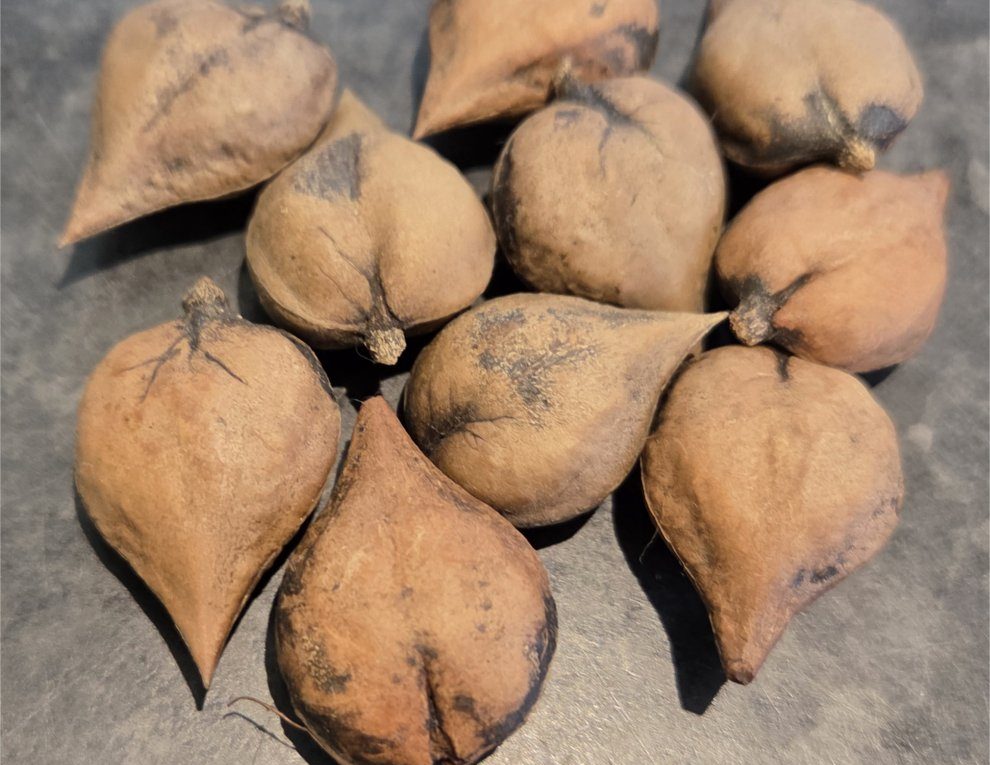
Heartnuts ripe in UK – end of September 2025
It’s now the end of September 2025, and we are having a bumper crop of Heartnuts. These are known as (Juglans ailantifolia var. cordiformis). Heartnut (Juglans ailantifolia var. cordiformis) is a native of Japan. But it grows equally well here in the UK (Zone 6).
The heartnut tree is best suited to well drained fertile sand and clay loam soils with a pH of 6 to 7. Plants produce a deep taproot, and they are intolerant of root disturbance. The leaves have a very pleasant aroma. They are suited to soils where black walnut and butternut grow wild. They are vigorous trees, growing 50 to 100 cm or more in a year, reaching a height of 15 m and a spread of 20 to 30 m. But generally they grow into a low height but bushy tree. The large, lush compound leaves are largely unaffected by most insect pests. Grafted trees will begin to bear in 1-3 years, with commercial production expected in 6-8 years. The trees are long-lived with annual production estimated at 1-3 tons per acre.

As the tree is more bushy than tall, it can produce a crop of nuts quite low down, which is very handy for harvesting.

A good year produces multiple bunches of nuts, much akin to bunches of grapes.

When the nuts are harvested, they are all dehusked. Some of the husks begin to soften and go black. At this stage, we put piles of the nuts into a bucket of water for a couple of days. Just to loosen more of the husk. Then we use a plaster mixer paddle fitted to a battery drill. The water is whisked into a black froth. This forces more of the husk off, into an almost clean nut.

Work does not stop there. Just for peace of mind, we water float them all. That includes any that are already dry. Any that float have air inside them, and probably no kernel. The heavy good ones sink to the bottom. We used to try to save the floaters, but it’s not worth it; we just throw them away.

Then they have to be dried, not crispy dry. But enough to stop any mould growing, but maintain the viability of the kernel.

They still need a couple of weeks for the kernel to mature and bring out the flavours. At that stage, you can crack them open. Place on a brick, with the side joint on the brick, and give the opposite joint a sharp tap with a hammer. You should get both halves of the shell split, enabling a fully unbroken kernel to be retrieved.

Happy nutting.